Multi-billion kwacha investments in initiatives to achieve food security have failed to break the vicious circle of hunger as the country faces yet another food deficit, raising questions on effectiveness of interventions.
In the 2024/25 farming season, Malawi Government through ministries, departments and agencies invested at least K300 billion in agricultural production. The investment was over and above several billions of kwacha pumped into agriculture in the past 15 years.
farming | Nation
From that huge investment this year, the country will yield 2.8 million metric tonnes (MT) of maize against the yearly demand of 3.5 million MT, leaving a deficit of 700 000 MT.
Ministry of Agriculture did not respond to our queries yesterday as line minister Sam Kawale said he was busy on the campaign trail, officials from the National Economic Empowerment Fund (Neef) and Green Built Authority (GBA) argued that they are doing their part, especially on irrigation.
Kawale stated last year that the ministry was allocated over K100 billion for agricultural production.
Out of this, he said K30 billion was for Neef, mega farms initiative received K16 billion, Lilongwe University of Agriculture and Natural Resources (Luanar) was allocated K3 billion and GBA K4 billion.
The package excluded the Affordable Inputs Programme (AIP) allocation of K161 billion, much of which went towards maize production.
Govt, entities, defensive
Presented with the scenario above, Kawale said he needed more time to get answers on some of the matters raised.
But GBA executive director Eric Chidzungu said that in 2024 they grew maize under irrigation at Nkopola scheme in Mangochi on 100 hectares (ha) where 250MT was produced and delivered to National Food Reserve Agency (NFRA).
He said: “The farmers themselves who are the land owners grew maize under rain-fed on 300ha and they produced 350MT. GBA also produced Maize under rain-fed at Chikwawa scheme in Salima. The project produced 750MT [15 000 bags] that was delivered to the national Strategic Grain Reserves (SGRs). GBA donated 21MT this year to the Salima District Council.”
Chidzungu said the Nkopola project used K300 million while Salima project cost K50 million and that this year production is under way at Nkopola where 800MT of harvest is estimated.
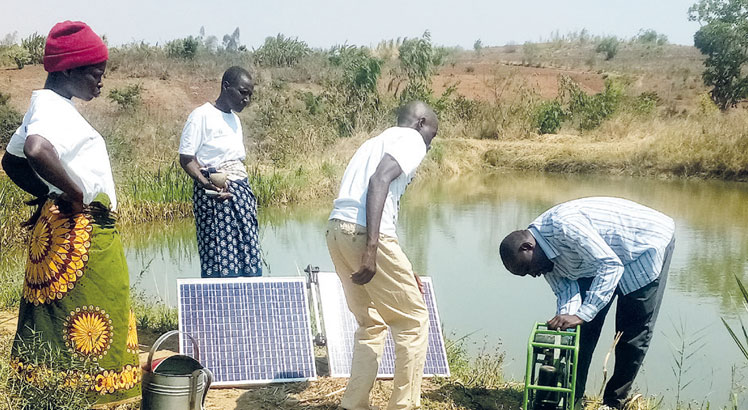
Neef, on the other hand, used K48 billion from April this year for phase one of the micro irrigation project aimed at partly covering the maize deficit this year, standing at 700 000MT.
Neef chief executive officer Humphrey Mdyetseni said they provided support towards irrigation farming, setting a target of 500 000MT of food, but have managed to get about 107 000MT.
“From this, 237 000MT is for maize, out of the targeted 250 000MT while 107 000MT is for beans and other crops from the expected 150 000MT. We hope that during the second phase, beginning September 1 to November, we will get about 150 000MT or so because most of the land has dried up,” he said.
Experts suggest solutions
But agriculture economist Steven Kayira noted that the disparity in investment and output reflects structural constraints such as erratic rainfall, limited extension services, high input costs, and slow roll-out of irrigation infrastructure.
He said the main gap is on how resources are deployed. He said with AIP, much of the budget goes to subsidised fertiliser distribution which does not automatically translate into higher yields.
On his part, agriculture policy expert Tamani Nkhono-Mvula said the situation predicts leakage on resources and failure to properly plan on time of investment.
He said: “Let the government invest in irrigation go into public private partnership with Press Agriculture so that we are able to irrigate and produce throughout the year.
“Neef has made some gains, but is the investment equalling the outcome? We continue investing lots of money, but continue importing as well. It is sad.”